Meb Keflezighi is American, and so am I
By Haimy Assefa, CNN
April 22, 2014 -- Updated 1915 GMT (0315 HKT)
Meb Keflezighi of the United States crosses the finish line to win the men's division of the Boston Marathon in downtown Boston on Monday, April 21. Meb Keflezighi of the United States crosses the finish line to win the men's division of the Boston Marathon in downtown Boston on Monday, April 21.
HIDE CAPTION
The 2014 Boston Marathon
<<
<
1 2 3 4 5 6 7 8 9 10 11 12 13 14
>
>>
STORY HIGHLIGHTS
Some have said Boston Marathon winner Meb Keflezighi is not truly American
Haimy Assefa writes that she faced similar questions of her identity when she arrived from Ethiopia
"I am black. I am Ethiopian. I am American," author writes
Editor's note: Haimy Assefa is a CNN news assistant in New York City covering breaking news in the Northeast region. She has a background in international affairs and multimedia storytelling.
(CNN) -- I was born in Ethiopia, raised in Oklahoma and Colorado, and ended up in Brooklyn, New York.
Coming to America from Ethiopia, a place where black and white were only colors that had little to do with race, I had to learn English, and also the language of identity.
In America, I was black.
So when some online commenters questioned whether Boston Marathon winner and Eritrean-American Meb Keflezighi is truly "American," it reminded me of my own experience as an immigrant who became a naturalized American citizen and embraced a new identity.
My parents, two brothers and I had an incredible life in Ethiopia.
We always had the newest toys and clothes from my father's frequent work-related trips abroad.
There were lots of friends and just as much family. Life was very communal, much like our style of eating.
Of course, Ethiopia was not perfect, but it was all that I knew.
My well-traveled parents wanted to grant my brothers and I the opportunities that America offered.
Movies shaped my brothers' and my perception of America. As far as I was concerned, everyone lived in massive homes, owned multiple cars and was generally happier.
Eddie Murphy, left, in the movie, Coming to America.
Eddie Murphy, left, in the movie, Coming to America.
The movie "Coming to America" stunned me the most. The images of homeless people and the rundown apartment occupied by the characters played by Eddie Murphy and Arsenio Hall contradicted the America of my imagination.
In the weeks before leaving Ethiopia, my older brother Yoseph and I used to stay up late talking about how a group of welcoming American friends, a brand new American car and a huge American house would soon be ours.
But landing in Oklahoma City, our expectations soon dissipated.
From the thick, humid air that permeates Oklahoma in August to the instant feeling of being an outsider, we began to breathe less easy.
In my fourth grade class, my peers were not as curious about me as I was about them. They avoided me and teased me for being African.
I mostly attributed my peers' distaste for me to my country of origin, until the day my older brother Yoseph came home from school after getting into a fight with a boy.
The boy had called him a "nigger."
I soon realized it wasn't just because of our funny accents or nationality that people treated us differently.
Source: CNN
Finding Ethiopia's future gold medalists
In America, we were seen as "black." I became painfully aware of my brown skin, my unruly hair, and the disapproving looks directed my way.
And so my introduction to American culture began.
By the time my family moved to Colorado, the outsized expectations of America were a distant memory.
I felt I had a better grasp of American culture and my new black identity. My English was fluent, without a trace of an accent; it allowed me to socialize with less reluctance.
I quickly made friends at my junior high school and became involved in extracurricular activities. I found comfort in having friends that looked like me.
By the time I was a teenager, working weekends serving meals at a retirement home, I learned the difference between subtle and overt racism.
There was man there who refused to speak to me, let me take his order, or even look me in the eyes because I was black. It was understood that only my white co-workers would interact with him.
The people I was close to would praise me by saying how well my parents raised me, and told me: "You're not like the rest of them. You're different."
I almost thought that they said these things as a compliment.
But I understood they were making an exception for me, in order to maintain their bigoted views of black and brown people. Because I defied the scope of their prejudice, I had to be unique.
This infuriated me.
I tried to take off-the-cuff comments from the elderly with a grain of salt. After all, they are from a different time period, when those sentiments were expected and accepted.
But it was when I heard my peers say, "You're not really black. You don't even act black," that I realized just how much the perceived singularity of the black identity transcends generations, age and gender.
This made me embrace my "blackness" more passionately, and I began to identify more as "black" than Ethiopian.
Author Haimy Assefa.
Author Haimy Assefa.
I wasn't quite Ethiopian enough for some of my Ethiopian friends who were convinced moving to the U.S. at such a young age caused me to lose some legitimacy. My vivid memories of Ethiopia and ability to speak my native language didn't cement my "Ethiopian-ness" to some.
And I did not live up to my American peers' expectations of being African-American either, even after becoming a naturalized citizen.
So there I was, the president of the Ethiopian Students Association, a member of the Black Student Alliance, and the founder of United Women of Color at Colorado State University.
I became quite the skilled juggler. But it was exhausting.
Tired of the balancing act, I began to care less and less about others' perceptions of me.
Eventually, I became proud of not fitting neatly into someone else's definition of being black or Ethiopian.
When I moved to New York, I felt at home, and met people with a similar understanding of black identity -- one that was varied and nuanced. They were more interested in having conversations about my experiences, and less interested in my color.
I no longer felt the weight of defending all of the different aspects of my identity to everyone.
But there is one thing about the black identity that remains constant: the complexities of the individual experiences that inform our identity.
Yes, I am black. I am Ethiopian. I am American.
I am also a journalist, a filmmaker, a sister, a daughter, a friend, an avid traveler and a woman who is constantly growing and evolving.
Stay in touch!
Don't miss out on the conversation we're having at CNN Living. Follow us on Twitter and Facebook for the latest stories and tell us what's influencing your life.
There is no doubt that my experiences, at times turbulent, have contributed to my racial identity. But my identity is never static. Instead, it remains fluid.
The reality is that my story is not singular simply because I was born abroad. It is distinctive in the way that each of us, as individuals, is distinct.
And so are our identities.
So when people say I am not "really black" or that Meb Keflezighi is not "really American," I'd invite them to run a mile in each of our shoes -- to see what we've gone through to become as uniquely American as anyon
Ethiopia Running የኢትዮጵያ ሩጫ The Art and the Tradition of Ethiopian Runners
Tuesday, April 22, 2014

Monday, April 21, 2014
Sunday, April 20, 2014
Endurance sports - Breaking down the elite men in the Boston field - ESPN
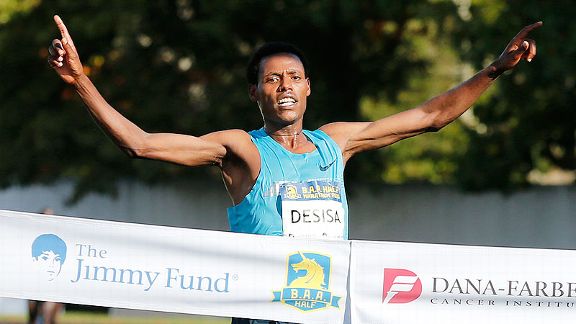 AP Photo/Michael DwyerLelisa Desisa is among the favorites after winning both the full and half-marathons in Boston in 2013.
Here's how the field stacks up.
THE FAVORITES
Lelisa Desisa (Ethiopia), 2:04:45 PR (Dubai, 2013)
Last year's winner is a good candidate to be the first back-to-back men's champion since 2008. Desisa has run only three marathons, all in 2013; in addition to Boston, he won his debut in Dubai and was second at the world championships in August. He's shown he can race well on any type of course, and in either a fast or tactical race. In his most recent race in mid-February, Desisa led eight men who finished under an hour to win a highly competitive half-marathon in the United Arab Emirates. Desisa's chances rise the longer the lead pack stays together.
Last year's winner is a good candidate to be the first back-to-back men's champion since 2008. Desisa has run only three marathons, all in 2013; in addition to Boston, he won his debut in Dubai and was second at the world championships in August. He's shown he can race well on any type of course, and in either a fast or tactical race. In his most recent race in mid-February, Desisa led eight men who finished under an hour to win a highly competitive half-marathon in the United Arab Emirates. Desisa's chances rise the longer the lead pack stays together.
Dennis Kimetto (Kenya), 2:03:45 PR (Chicago, 2013)
The fastest man in the field broke the Chicago Marathon course record by almost a minute last October. His PR makes him the third-fastest person in history on a record-eligible course. Two things keep us from tabbing Kimetto as the overwhelming favorite. First, his three career marathons have been on flat, fast courses instead of something with Boston's ups and downs. Also, he missed a key half-marathon tuneup race in February with an ankle injury, then ran only 64:56 at a half-marathon in March. If Kimetto is healthy, look for him to push in the Newton hills to get a clear break from the field.
The fastest man in the field broke the Chicago Marathon course record by almost a minute last October. His PR makes him the third-fastest person in history on a record-eligible course. Two things keep us from tabbing Kimetto as the overwhelming favorite. First, his three career marathons have been on flat, fast courses instead of something with Boston's ups and downs. Also, he missed a key half-marathon tuneup race in February with an ankle injury, then ran only 64:56 at a half-marathon in March. If Kimetto is healthy, look for him to push in the Newton hills to get a clear break from the field.
THE CONTENDERS
Micah Kogo (Kenya), 2:06:56 PR (Chicago, 2013)
Kogo finished second at Boston last year in his marathon debut. He dropped his PR to 2:06:56 in finishing fourth at Chicago in October. His trajectory is the sort that has led to many Boston victories. Kogo has won an Olympic bronze medal in the 10K and formerly held the world road record for the distance.
Kogo finished second at Boston last year in his marathon debut. He dropped his PR to 2:06:56 in finishing fourth at Chicago in October. His trajectory is the sort that has led to many Boston victories. Kogo has won an Olympic bronze medal in the 10K and formerly held the world road record for the distance.
Tilahun Regassa (Ethiopia), 2:05:27 PR (Chicago, 2012)
Regassa is a good example of the young, fearless racers who have defined world-class marathoning in recent years. After debuting in 2:05:27 at Chicago in 2012, the 24-year-old won Rotterdam last spring, also in 2:05. Regassa has won many top shorter events on the U.S. and international road circuit.
Regassa is a good example of the young, fearless racers who have defined world-class marathoning in recent years. After debuting in 2:05:27 at Chicago in 2012, the 24-year-old won Rotterdam last spring, also in 2:05. Regassa has won many top shorter events on the U.S. and international road circuit.
Wilson Chebet (Kenya), 2:05:27 PR (Rotterdam, 2011)
One way to pick potential winners is to focus on those with a history of winning. In that case, keep an eye on Chebet, who has won Amsterdam three times and Rotterdam once, each in 2:05. In his one Boston appearance, Chebet was fifth in 2012. It's hard to know if that was because he's only good on pancake-flat courses like Amsterdam and Rotterdam, or if he was affected more than his competitors by that year's heat.
One way to pick potential winners is to focus on those with a history of winning. In that case, keep an eye on Chebet, who has won Amsterdam three times and Rotterdam once, each in 2:05. In his one Boston appearance, Chebet was fifth in 2012. It's hard to know if that was because he's only good on pancake-flat courses like Amsterdam and Rotterdam, or if he was affected more than his competitors by that year's heat.
Gebre Gebremariam (Ethiopia), 2:08:00 PR (New York City, 2011; also 2:04:53 on point-to-point Boston in 2011)
Gebremariam won his debut marathon in New York in 2010, but since then hasn't been able to convert being with the leaders late in the race into a victory. He wound up third of the trio that were together in the last mile last year.
Gebremariam won his debut marathon in New York in 2010, but since then hasn't been able to convert being with the leaders late in the race into a victory. He wound up third of the trio that were together in the last mile last year.
Markos Geneti (Ethiopia), 2:04:54 PR (Dubai, 2012)
Geneti should be either really fit or really tired. In January, he placed second at the Dubai Marathon in 2:05:13, just 17 seconds off the PR he set there two years ago. Geneti won his marathon debut in Los Angeles in 2011. He hasn't won since, and was sixth here last year.
Geneti should be either really fit or really tired. In January, he placed second at the Dubai Marathon in 2:05:13, just 17 seconds off the PR he set there two years ago. Geneti won his marathon debut in Los Angeles in 2011. He hasn't won since, and was sixth here last year.
Lusapho April (South Africa), 2:08:32 PR (Hanover, 2013)
A 2:08 guy might seem out of his league among all the sub-2:06 runners in this year's field, but April finished third at New York City last November among another seemingly superior field. As at New York City, finishing high on Boston's ever-changing course is usually more about racing smart than running fast.
A 2:08 guy might seem out of his league among all the sub-2:06 runners in this year's field, but April finished third at New York City last November among another seemingly superior field. As at New York City, finishing high on Boston's ever-changing course is usually more about racing smart than running fast.
THE AMERICANS
Ryan Hall, 2:06:17 PR (London, 2008; also 2:04:58 on point-to-point Boston in 2011)
Hall enters as both the fastest American and the biggest question mark in the field. His 2:04:58 here in 2011 is the fastest American time on the course by more than three minutes. But the last marathon Hall finished was the Olympic trials in January 2012. Since then, he's dropped out of the Olympics and missed Boston once and New York City twice because of injury. To prep for this year's Boston Marathon, Hall trained at altitude in Ethiopia. He hasn't raced at any distance since last August. Hall says he's had his best training in a long time for this year's race. Still, it's anyone's guess what he'll do Monday.
Hall enters as both the fastest American and the biggest question mark in the field. His 2:04:58 here in 2011 is the fastest American time on the course by more than three minutes. But the last marathon Hall finished was the Olympic trials in January 2012. Since then, he's dropped out of the Olympics and missed Boston once and New York City twice because of injury. To prep for this year's Boston Marathon, Hall trained at altitude in Ethiopia. He hasn't raced at any distance since last August. Hall says he's had his best training in a long time for this year's race. Still, it's anyone's guess what he'll do Monday.
Meb Keflezighi, 2:09:13 PR (Olympic Marathon Trials, 2012)
Keflezighi will be a few weeks away from his 39th birthday on race day, but we learned long ago never to bet against him. His most recent marathon, a 2:23 at New York City last November, was by the far the slowest of his career. But in the past few years, Meb has also twice set a PR, won the Olympic Marathon Trials and placed fourth at the 2012 Olympics. So far this year, he's won the U.S. half-marathon title in January, and placed 10th in a world-class field at last month's NYC Half.
Keflezighi will be a few weeks away from his 39th birthday on race day, but we learned long ago never to bet against him. His most recent marathon, a 2:23 at New York City last November, was by the far the slowest of his career. But in the past few years, Meb has also twice set a PR, won the Olympic Marathon Trials and placed fourth at the 2012 Olympics. So far this year, he's won the U.S. half-marathon title in January, and placed 10th in a world-class field at last month's NYC Half.
Jason Hartmann, 2:11:04 PR (Chicago, 2011)
Hartmann was the first American, and fourth overall, the last two years at Boston. His recent consistency ended at New York City in November, where he dropped out. If he's fit, look for him to lay off the fireworks up front and, as in 2012 and 2013, pass overly aggressive early racers in the closing miles.
Hartmann was the first American, and fourth overall, the last two years at Boston. His recent consistency ended at New York City in November, where he dropped out. If he's fit, look for him to lay off the fireworks up front and, as in 2012 and 2013, pass overly aggressive early racers in the closing miles.
Nick Arciniaga, 2:11:30 PR (Houston, 2011)
Arciniaga won the 2013 U.S. title with his victory at October's Twin Cities Marathon, a second-place finish at the 2011 Houston Marathon and an eighth-place finish at the 2012 Olympic Marathon Trials. But he's also had some disastrous marathons. He dropped out of Boston in 2012 after doing some of the early leading.
Arciniaga won the 2013 U.S. title with his victory at October's Twin Cities Marathon, a second-place finish at the 2011 Houston Marathon and an eighth-place finish at the 2012 Olympic Marathon Trials. But he's also had some disastrous marathons. He dropped out of Boston in 2012 after doing some of the early leading.
Brett Gotcher, 2:10:36 PR (Houston, 2010)
Like his former training partner Arciniaga, Gotcher has been inconsistent throughout his marathon career. His PR dates from his debut in 2010. He placed fifth at the 2012 Olympic Marathon Trials but hasn't run a good marathon since.
Like his former training partner Arciniaga, Gotcher has been inconsistent throughout his marathon career. His PR dates from his debut in 2010. He placed fifth at the 2012 Olympic Marathon Trials but hasn't run a good marathon since.
Jeffrey Eggleston, 2:12:03 PR (Chicago, 2013)
Eggleston has run in the last two world championship marathons, so he won't be intimidated or spooked into doing something silly by the strong international field. Don't be surprised if he moves into the top 10 once some of the men gunning for the win fall apart.
Eggleston has run in the last two world championship marathons, so he won't be intimidated or spooked into doing something silly by the strong international field. Don't be surprised if he moves into the top 10 once some of the men gunning for the win fall apart.
Abdi Abdirahman, 2:08:56 PR (Chicago, 2006)
A strong performance by the four-time Olympian would be a surprise. Abdirahman hasn't finished a marathon since placing third at the Olympic Marathon Trials in January 2012
A strong performance by the four-time Olympian would be a surprise. Abdirahman hasn't finished a marathon since placing third at the Olympic Marathon Trials in January 2012
Subscribe to:
Posts (Atom)