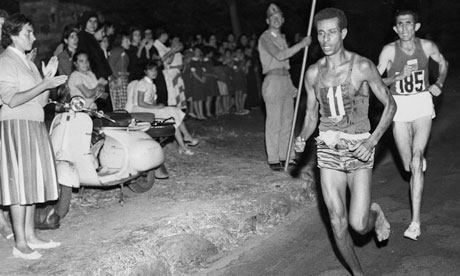
Few could have predicted when Italy hosted the 1960 Olympic Games that come the opening ceremony Rome would be cavorting in the midst of an economic boom. But the legacy of Fascist rule, which had ended 17 years earlier, still remained. And while many axes and insignia had been chipped away in a post-regime iconoclastic orgy, nowhere in the capital was the regime's presence more evident than around the two Olympic sites.
Paved with ancient-style mosaics of Fascist sportsmen, slogans and 264 references to Benito Mussolini, the Via dell'Impero, the main Foro Italico thoroughfare leading from the imposing Mussolini obelisk to the Olympic stadium, courted most controversy. Flanked by huge blocks of travertine stone, it was etched with key events in Fascist history, in the midst of which was the conquest of the Abyssinian capital Addis Ababa in 1936. It was into this environment that Abebe Bikila, a private in Haile Selassie's Imperial Army, stepped.
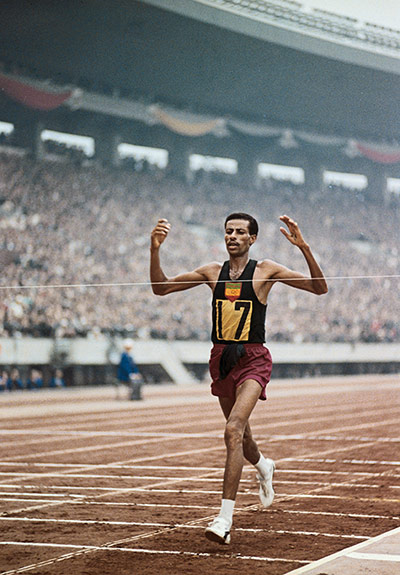
Small, lean, barefooted, in bright red shorts and a green vest sporting the number 11, Bikila was a last-minute replacement in the marathon for an injured team-mate. His challenge was taken far from seriously. "Who's this Ethiopian," questioned one commentator. He was not alone.
Bikila's unofficial personal best for the 42.2km – better than the world record – was widely dismissed as impossible. He arrived in Rome with one pair of running shoes but they were ruined in training in the month before the Games. With his new ones causing blisters, his decision to compete barefoot, feet toughened by miles of shoeless training on the high Ethiopian plains, only added to the general derision.
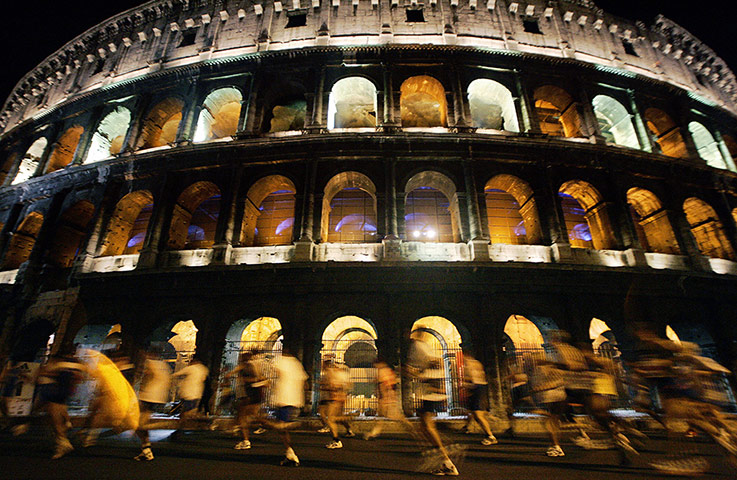
The marathon began in the heat of the late afternoon at the Campidoglio, Rome's civic centre set above the Forum. The athletes followed Mussolini's triumphant thoroughfare past the Coliseum, the Palatine Hill and the Circus Maximus.
Here, settled at the back of the leading pack, Bikila glided past the Obelisk of Axum that had been plundered from Abyssinia. Continuing south and exiting the city, a breakaway pack began to materialise: "With the English Kiley, there's the Irishman Messipy [Messitt], the Belgian Van der Blicher, the Morrocans Rhadi and Saudy, and there's that unknown Ethiopian we saw earlier," announced the commentator. "He's called Abebe Bikila. He's barefoot."
At the 32km mark, in Rome's peripheral countryside, with the sun disappearing behind the city, the runners turned from a somewhat bizarre section of the capital's orbital road and on to the Appian Way that used to connect the ancient city with Brindisi, on Italy's south-eastern coast.
Breaking with the tradition of daytime Olympic marathons that concluded in the stadium, the early evening start maximized the spectacle as the athletes negotiated 8km of the cypress-tree-lined Appian Way, in darkness. As Bikila's bare feet rhythmically kissed the uneven stones, the half moonlight, the illuminated ancient Roman monuments and hundreds of torch-bearing soldiers intensified the atmosphere and added to the drama. As Alberto Cavallari wrote in his Corriere della Sera report: "It wasn't a marathon it was 'Aida', with the Romans roadside making up the chorus."
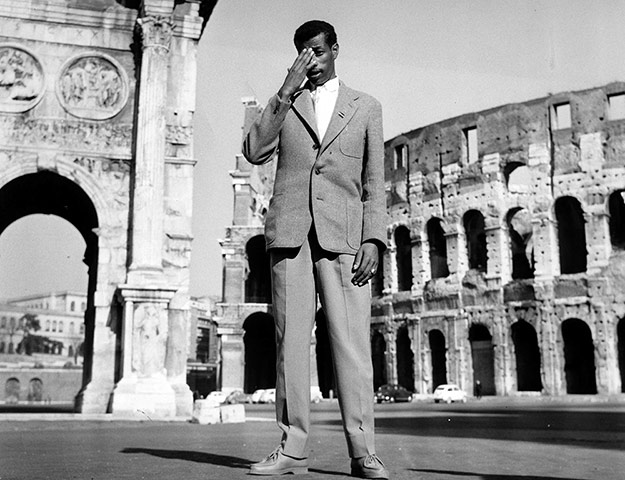
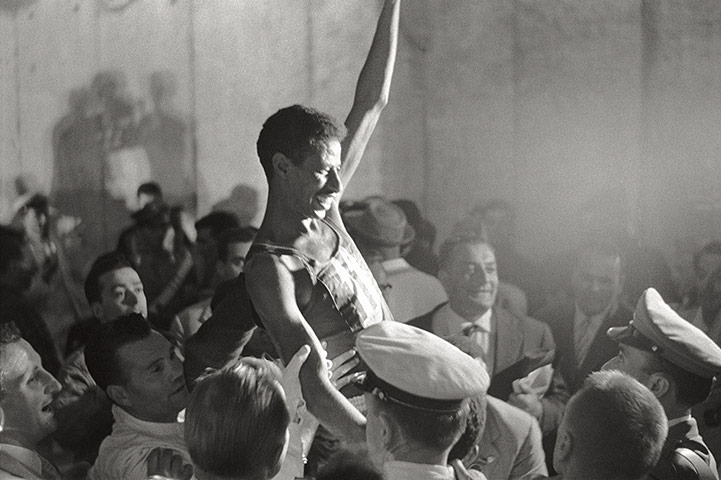
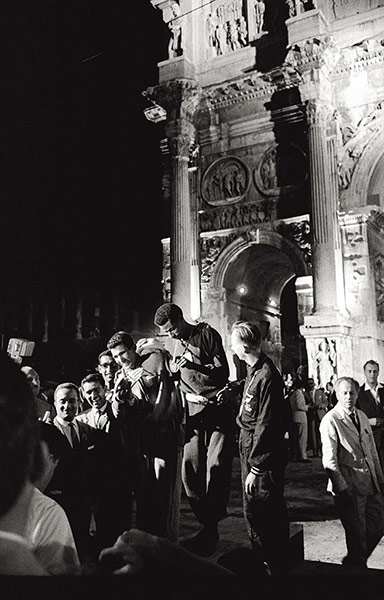
Re-entering the city at the Porta San Sebastiano, with impeccable timing Bikila left his sole pursuer, the Moroccan Rhadi Ben Abdesselam, just as he repassed the Axum obelisk. Finishing in 2hr 15min 16sec, Bikila shattered the Olympic record and set a new world best, before dancing a jig of joy beneath the Arch of Constantine where many of his rivals simply collapsed.
Coming less than 25 years after Mussolini's forces had conquered his capital at the end of a cruel colonial war, it was the significance of his victory as much as the ease with which he had consumed the capital's kilometres that fascinated.
Marking the rise and future dominance of East African middle- and long-distance runners, in the presence of the all-white South African team that the International Olympic Committee chose not to challenge, and against the vastly better funded and better equipped Soviet, US and European athletes, Bikila ran his name and that of his country into history.
But his victory was not simply that of Ethiopia, it was also a triumph for Rome and the Games. Transcending his lack of shoes, for which he is most fondly remembered, he dramatically closed the final event under the lights and arch of a long-departed emperor while, at the same time, eclipsing the memory of a more recent wannabe.
Following the fierce parliamentary debates over the negative image presented by the Fascist-built venues to the outside world, and the retaliatory neo-Fascist graffiti that marked the city in the buildup the Games, there was no better, more apt or powerful demonstration of Italy's break from the past than this glorious, individual victory by an ex-colonial subject.
As the editor of the British Olympic Association's magazine World Sports condescendingly concurred, in his report from Rome: "It is a scene to remember – a moment of theatrical drama; a moment so unusual in modern world
athletics, when a virtual unknown from an insignificant country crosses the seas and conquers the heroes. It is a fine, unsophisticated, illogical victory […] This […] was an historic Olympic marathon both in terms of performance and backcloth […] its drama was in its setting, presentation and outcome."
Despite the years of preparation, the Games' greatest and most enduring moment was not only completely unplanned, it was totally unimaginable. Bikila, this tiny, barefoot former colonial subject, mixed the unexpected with drama to create a scriptwriter's dream and become the greatest symbol of the new, rejuvenated, post-Fascist country.
What the Observer said
The Observer: Sunday 11 September 1960
Bikila Abebe, a 28-year-old member of Emperor Haile Selassie's bodyguard, won the marathon gold medal in the last big event of the Olympics last night. Abedisiem Rhadi of Morocco was second and B. Magee, of New Zealand. Third. Abebe's time was 2hr 15min 16.2sec, which was 7min 47sec better than Emil Zatopek's Olympic record. In fact, the first 15 all improved on the old record. Prowess in big international cross-country races on the Continent had made Rhadi one of the more fancied competitors, but none outside East Africa had heard of Abebe, who won the greatest marathon in the 64 years of Olympic history.
What happened next?
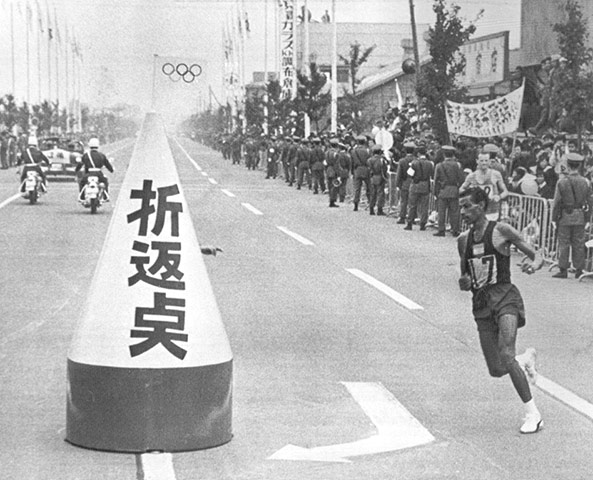
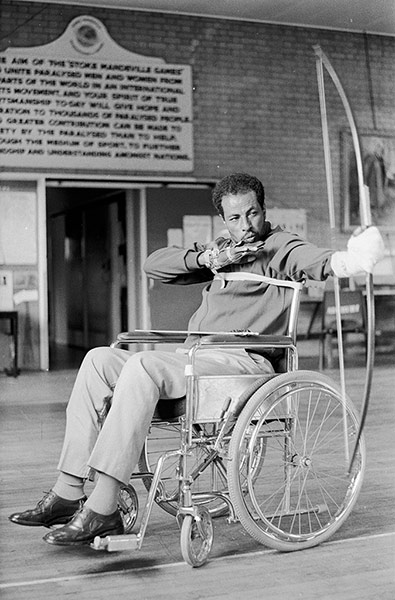
Six weeks before the 1964 Tokyo Olympics, Bikila was taken ill with appendicitis and underwent surgery. Still recovering when he arrived in Japan, he went on to become the first athlete to retain the Olympic marathon title. In 1968, a car accident in the city of Sheno, 76km from Addis Ababa, left Bikila confined to a wheelchair. His competitive spirit undiminished, he won gold in a 25km cross-country sledge competition in Norway in 1970. Suffering complications from his paralysis, he died in October 1973 and was buried in the presence of Selassie.
On the 50th anniversary of his win, the 2010 Rome marathon was dedicated to Bikila's memory and, appropriately, Ethiopia claimed a male and female double. The women took first, second and third places, and the men's winner, Siraj Gena, picked up a €5,000 bonus, offered by the race organiser, for completing the final 300m barefoot. Although few visitors to Rome could have noticed the small plaque mounted on the wall of the Foro dei Imperiali dedicated to Bikila, he remains a local hero, the "escaping Ethiopian" who ran Italy into the democratic dawn.
Sport Italia by Simon Martin, published in 2011 by IB Tauris, narrates the history of modern Italy through the national passion of sport.
• This article was amended on 26 April 2012 to clarify that the person referred to in a commentary as Messipy, was in fact Bertie Messitt.