Abebe Bikila 1960, 64& Feyisa Lilesa 2016

,

Monday, December 2, 2013

The Great Ethiopian Run: in the footsteps of Haile Gebrselassie | Life and style | The Guardian


It's a crazy, joyous race at 2,300m above sea level in Addis Ababa, and it's the adrenaline as well as the altitude that leaves competitors breathless after the Great Ethiopian Run
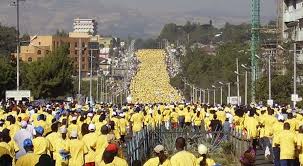
Mass of runners in Great Ethiopian Run
More than 38,000 runners hit the streets of Addis Ababa for the Great Ethiopian Run, Africa's biggest race. Photograph: Dan Vernon
I am standing at the start line of the Great Ethiopian Run: not only the biggest race in Africa but one of the continent's biggest talent-spotting contests. Officially there are 38,000 of us, all in yellow-and-green race T-shirts, jostling and shoving and staring down a line of police with batons. But hundreds of others have sneaked into line, with home-brewed kit, swelling the numbers still further. A marshal warns me, "Don't try to get in front when they start – you'll be trampled!", then there's the blast of a horn, a rising crackle of noise, and the police cordon sprints for safety. Ahead of me two men lose their shoes in the tumult – and don't return – and I wonder: what the hell have I let myself in for?
For others, however, this 10km race around the hills of Addis Ababa, at an altitude of 2,300 metres, offers the chance to follow in the footsteps of the great Ethiopian runners: Abebe Bikila, who won the 1960 Olympic marathon in Rome running barefoot; the revered Haile Gebrselassie, 10,000m gold medallist at the Atlanta and Sydney Olympics; and the current 5km and 10km world record holder Kenenisa Bekele. Previous winners in the race's 13-year history have gone on to win major marathons and Olympic medals. The race – which is shown live on Ethiopian TV – is not just a showcase for runners, but for the country, too.
That it takes place at all is down to Gebrselassie, who many see as a future president of Ethiopia. Invited by Brendan Foster, the founder of the Great North Run, to come over to Newcastle, Haile responded: "Why don't you help me to start a Great Ethiopian Run?" So Foster did.
"The whole country is running," says Gebrselassie, offering Ethopian coffee so strong you suspect it partly explains the speed of the country's athletes. "We try to rise up the people to do something. Sport has just one language, and when you encourage people through sport you encourage every sector, whatever their job. One religion, one culture, one language – and that is running."
But caffeine-fuelled beverages aside, why are Ethiopian distance runners so good? "It's because of opportunities here," says Gebrselassie, who spends the days before the race patiently smiling, chatting and posing for photographs. "Plus the lifestyle: the kids walk to school – no, they run! – every day. I ran six miles every day to school and back so my training started when I was three or four." Unsurprisingly, the Great Ethiopian Run even has a race for the under fives.
Though there are a few international runners – a team from Norway and a speedy gang from Birmingham – the race at elite level is tough for most foreigners because of that altitude. While your legs feel good to go, your lungs wheeze and moan in protest. It's like someone has strapped an iron band around your chest and compressed it.
My first experience of this comes on a track built by Bekele high in the mountains. Bekele himself has come to train, and we jog very slowly with him. At least, my GPS watch says it's slow – my lungs appear to think I've just finished a sub-four-minute mile. This is why athletes train at altitude – and why those born at it have an advantage – the body adapts to the relative lack of oxygen. But not, of course, on day one. And not when you are trying not to wheeze too loudly behind a multiple Olympic gold medallist.
Great Ethiopian Run: singing and dancing runnersRunners sing and chant en route. Photograph: Dan Vernon
After warming up, we follow Bekele into the woods where he and many other elite athletes train. He slips away in a matter of seconds, leaving us to puff and tootle around a few miles of hyena territory. "That's OK, they only come out at night," says a cheery runner. "Just don't be last!"
But by race day, either I've adapted slightly or the adrenaline has kicked in. Once I summon the courage to get out of the sidelines and into the sea of runners, I'm away. The first few kilometres are very slow, because of the sheer press of people, many of whom are too interested in talking, showing off and having fun to care what time they finish in, but the atmosphere is incredible. There are spontaneous outbreaks of loud joyous songs and chanting. Others dance and shout. I can't stop smiling.
The noise quietens – though only very slightly – as those hills kick in. I'm surrounded by friendly, chatty people, though the man who wants to talk to me about my impressions of Ethiopia probably shouldn't have chosen an uphill stretch to do it. Where some races have hi-tech drizzle showers to cool you off, this one has a full-on garden hose. Most people stop to dance in its makeshift shower.
Way, way, too soon (something I have never thought in a race before, and suspect never will again) the 9km marker is in sight and it's just the home stretch. The men's winner, Atsedu Tsegay, finished a long time ago and is about to be presented with his trophy by Gebrselassie.
My finish time is six minutes slower than my personal best, but that's irrelevant: this is the craziest race I've ever done and one of the best experiences of my life. As Haile eloquently puts it: "The best way to get rid of all stress and everything is to sweat a bit. It's a kind of treatment." And one that I would happily sign up to again.

Sunday, December 1, 2013

Uganda dominates Cross Country meet

Uganda dominates Cross Country meetPublish Date: Dec 01, 2013
Uganda dominates Cross Country meet
  • mail
  • img
Bezabh Belay, Ronald Musagala and Joshua Cheptegei with their medals. Photo by Norman Katende
newvision

By Norman Katende
Results Individual category
Men
Ronald Musagala (KU) 31:22.2
Bezabh Belay (ETH) 31:33.8
Joshua Cheptegei (Bugema) 32:26.2
Abu Mayanja (KU) 33:03.5
Martin Chemtingen (KU) 33:08.7
Women           
Winnie Nanyondo (KU) 21:29.7
Dorcus Ajok (Ndejje) 21:44.7
Annet Chebet (Ndejje) 21:54.7
Prim Twikirize (Ndejje) 22:10.4
Thembi Baloyi (RSA) 22:12.3
Team results
Men
Kampala University 16 pts
UCU 80pts
Women results
Ndejje University 9pts
Tshwane University 22pts
Kampala University 25pts
RONALD Musagala beat Ethiopia’s Bezabh Belay to win the Africa University Cross Country championships and also lead Uganda’s Kampala University to the team event gold medal at the Africa University Cross Country Championships that took place at Entebbe Golf Course on Sunday.
Winnie Nanyondo won the women’s event but a 2-3-4 finish from Ndejje University’s Dorcus Ajok, Annet Chebet and Prim Twikirize, saw them deny Kampala University a clean sweep of gold medals in both the individual and team events in an exciting race held on a challenging course.
Musagala put up a good run and by the 3km mark, he was in control of the race with Belay and Uganda’s Joshua Cheptegei from Bugema University dictating the pace.
It all looked like he was just setting the pace for Belay, who looked confident and keeping a two meter gap just behind them in the 10.5km race but when they reached the 9.5km mark, Musagala sped off and he never looked behind as he strolled to victory in a time of 31 minutes 22.2 seconds, with Belay coming home over ten seconds after.
“It was a challenging course but I have been working on my endurance which has helped me a lot in this race,” said Musagala, who is a World Athletics Senior Championship 800m semi-finalist.
“It was too hot and the course was challenging,” Belay said.
It was a good result for Kampala University as Nannyondo also held on despite tough competition from Ndejje and Tswane University’s Thembi Baloyi to win.
It was always going to be close but her decision to sprint earlier than planned was enough to give her a huge gap of over 15 seconds as the middle distance runners also dominated the women event. 
Nannyondo and Ajok are 800m and 1500m runners.
The race was a warm up for the W

Wednesday, November 27, 2013

Netsanet Gudeta & Atsedu Tsegay Win at the Great Ethiopian 10km Run | East Africa News

Netsanet Gudeta and Atsedu Tsegay became the new champions at the Great Ethiopian Run 10km in Addis Ababa on Sunday, according to the report by iaaf.org.
Both runners had to work hard for their victories on a tough new course in the northern part of the Ethiopian capital around the Jan Meda Race Ground.
The changes in start and finish location from its traditional venue in Meskel Square had been forced upon the organizers as a result of road and rail construction work in the city.
Tsegay won the 13th edition of the race in a time of 29:21, the slowest winning time since Gebregziabher Gebremariam won in 2002.
However, the winning time didn’t matter to Tsegay, who fought hard over the second part of the course to claw back a 10-metre deficit over a hilly section of the route between 6km and 9km.
A group of 11 passed the halfway mark in 13:38, after the leading pack was gradually whittled down to five by 6km and three by 7km.
At this point 2013 Boston Marathon champ Lelisa Desisa started to struggle. Indicative of the new undulating route, the final 3km metres were covered in 9:31 compared with the opening 3km of 8:18, and the last three kilometres turned into a war of attrition, as Tsegay took the lead just before the 9km point as he headed back up the final hill past Menelik Hospital and along the edge of Jan Meda.
Tsegay, continuing the tradition of a different man winning every year, came home four seconds clear of Adugna Tekele, with Hunegnaw Mesfin a further three seconds back.
In the women’s race, Netsanet Gudeta ran a clever tactical race which saw her overhaul long-time race leader Atsede Bayissa at the 7km point.
Bayissa stormed through the first 5km in 15:08 but could only manage 18:42 over the race’s second half as she drifed back to third. By comparison, Gudeta’s splits were 15:20 and 18:03 and she crossed the line in 33:23. Tadelech Bekele ran strongly over the final two kilometres to take second in 33:44.
Gudeta, who hails from the small town of Bekoji which has produced the likes of Kenenisa Bekele, Derartu Tulu and Tirunesh Dibaba, only requested a start number on the day before the race after deciding that her good form from her recent Coca Cola Series win in Addis Ababa back in September was still there.
Gudeta is part of a training group which also includes last year’s Great Ethiopian Run champion Aberu Kebede, Aselefech Mergia, Sule Utura and Koreni Jelila.
An estimated 30,000 runners finished the race. Kenya’s recently crowned World Marathon Majors champion Priscah Jeptoo of Kenya joined former champions Haile Gebrselassie, Tsegaye Kebede and Gebremariam Gebregziabiher in presenting the prizes.
It is to be remembered that the Great Ethiopian Run has been the first winner of the AIMS social award. AIMS(Association of International Marathons and Distance Races) had presented the award, which highlights races working towards achieving the United Nations Millennium Development Goals, to the successful Ethiopian 10km race during the first AIMS Best Marathon Runner Awards Gala Dinner on 8 November 2013 in Athens, Greece.
The eight Millennium Development Goals include eradicating extreme poverty and hunger, combatting disease, decreasing child mortality, promoting gender equality and the empowerment of women and ensuring environmental stability.